


What is Göbekli Tepe? 🪨
Göbekli Tepe of Sanliurfa (southeast Turkey) is the world’s oldest Megalithic site. It’s excavation uncovered a unique, ancient complex that has gained lots of attention, as it brings question to the current views of science and history. Much of the site, including potential burial grounds or other features, may still lie underground.
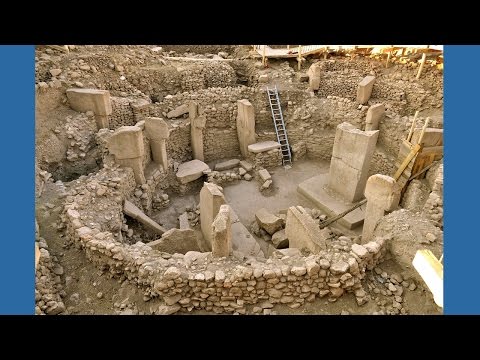
Mainstream research suggests that the settlement was inhabited from at least c. 9500 to 8000 BCE, during the Pre-Pottery Neolithic. These dates mean the site’s age is estimated to be around 12,000 years old or more, making it one of the oldest known monumental structures. It is famous for its large circular structures that contain massive stone pillars; the world’s oldest known megaliths.
Many of these pillars are decorated with anthropomorphic details (human traits, emotions, or intentions to non-human entities), clothing, and sculptural reliefs (where sculpted pieces remain attached to a solid background of the same material) of wild animals, providing archaeologists rare insights into prehistoric religion and the particular iconography of the period.
The 15 metre (50 feet) tall, 20 acre tell (an artificial topographical feature, a mound consisting of the accumulated and stratified debris of a succession of consecutive settlements at the same site) is densely covered with ancient domestic structures and other small buildings, quarries, and stone-cut cisterns (a waterproof receptacle for holding liquids) from the Neolithic, as well as some traces of activity from later periods.
Göbekli Tepe also features numerous animal depictions on its pillars and stone sculptures, including foxes, cranes, snakes, wildcats, aurochs, gazelles, as well as various other creatures. Researchers say that this suggests a significant role of animals in the spiritual world of the people who frequented the site.
Göbekli Tepe Photos and Videos 🎥
Here are some pictures of Göbekli Tepe, including Göbekli Tepe skulls/anthropomorphic head artifacts (image 4) discovered by researchers of the site (note skull fragments were also found), Göbekli Tepe statues (image 5) and art/symbols of animals and a headless man carved into ‘Pillar 43’ (image 6).


In addition, here are some videos about the archaeological site, including insights from Graham Hancock and ‘Bright Insight‘.
Video 1, 2, & 3 – ‘Bright Insight’ on Gobekli Tepe
In these videos,from ‘Bright Insight’ discusses the following points.
Ancient History:
- Human civilization is far older and more advanced than mainstream history claims.
- A global cataclysm (around 12,900–11,600 years ago) reset civilization.
- Evidence of this event is preserved in ancient sites, especially Göbekli Tepe.
Göbekli Tepe:
- Dated back to around 11,600 years ago (far older than mainstream civilization beliefs), Göbekli Tepe has massive, precise stone structures with:
- Advanced carving and engineering.
- Perfect north-south alignment (true north, not magnetic).
- Astronomical/constellation symbolism.
- Jimmy suggests that the site may record a comet impact event and could act as a warning or time capsule for future civilizations.
- Mainstream interpretations (e.g. “skull cult”) are misleading or incomplete.
Global Cataclysm:
- Multiple pieces of evidence link to a global disaster; the Younger Dryas event (around 12,900 years ago), where there was sudden:
- Climate change and end of the Ice Age.
- Rapid sea level rise.
- Mass extinction (especially large mammals like mammoths).
- Geological markers such as a “black mat” layer with nanodiamonds, iridium, and melt glass are indicators of this impact (and a “great flood” is also referenced throughout multiple ancient texts).
- A comet/asteroid impact likely caused this widespread destruction.
Cyclical Catastrophes (based on ideas from Randall Carlson and Graham Hancock):
- Earth undergoes repeating cycles of catastrophe.
- There may have been multiple resets over tens of thousands of years.
- This explains gaps in recorded history and why advanced knowledge appears “suddenly” in ancient civilizations.
Underground Cities/Complexes (e.g. in Turkey):
- Multi-level, ventilated, interconnected.
- Could house thousands of people and animals.
- May have been built as shelters from past cataclysms
Critique of Mainstream Science:
- Important evidence is ignored or downplayed.
- Institutions may be influenced by bias, funding, or entrenched narratives.
- Alternative interpretations (cataclysm and advanced ancient civilizations) are not taken seriously enough.
- Understanding this history is important so we don’t “reset” back to the Stone Age again.


Video 4 – Göbekli Tepe, Turkey, with Graham Hancock, Andrew Collins & Hugh Newman on the ‘Origins’ Tour
This video shares footage directly from the site, where Graham Hancock, Andrew Collins, and Hugh Newman describe Göbekli Tepe as a very ancient, unique, and possibly paradigm-shifting site that could force a rethink of early human civilization and other megalithic structures.
Dating:
- Estimated to around 9,400 BC (~11,600 years ago)
- This aligns with radiocarbon dating evidence
- Suggested to represent a very early, advanced phase of construction
Nature of the Site:
- The mound itself is man-made.
- Considered a “time capsule” because:
- It was deliberately buried.
- It has minimal contamination from later cultures.
- Contains massive carved stones with symbolic imagery.
Symbolism:
- Pillars feature complex carvings of animals (e.g. vultures, scorpions, lion-like figures) and abstract symbols (e.g. “handbag”-like shapes).
- These carvings are described as highly symbolic and open to multiple interpretations (possibly astronomical or mythological).
Big Implication:
- Göbekli Tepe may challenge the accepted timeline of civilization.
- Other megalithic sites (traditionally dated to 5,000–6,000 years ago) appear to actually be much older.
- It could force a re-evaluation of global ancient history.

You can read more on ancient history here.


