
Article Overview 🔎
The Double Slit Experiment Explained 🔬
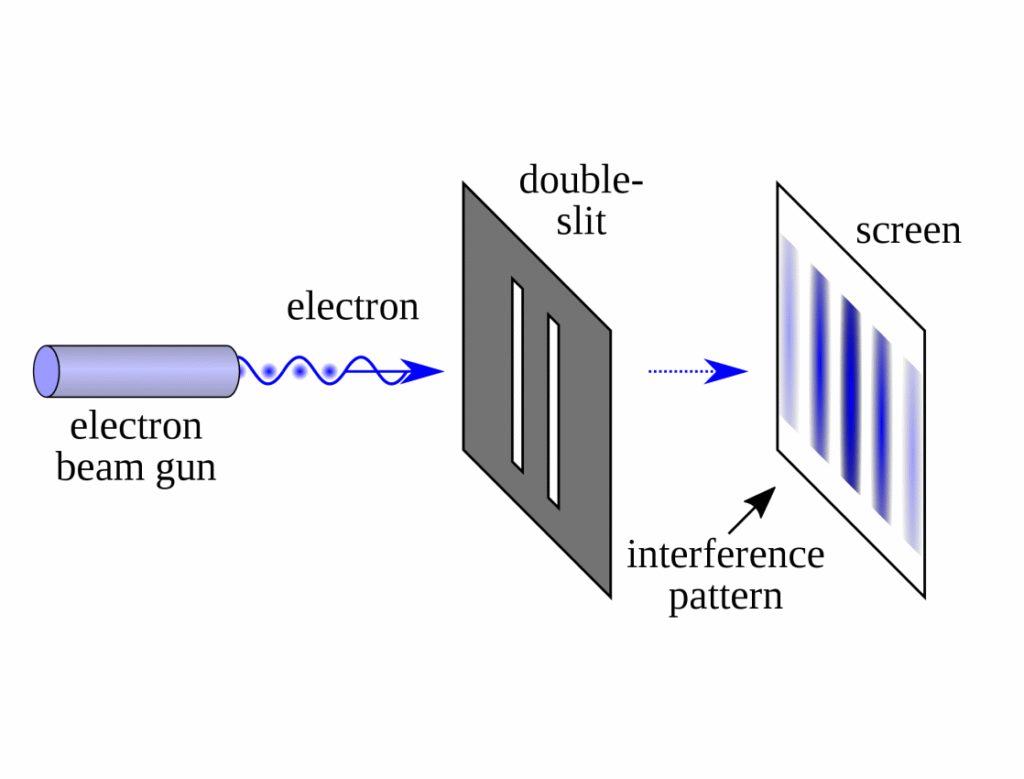
The Double Slit Experiment is one of the most famous, eye-opening experiments in quantum physics. It gives a different insight into how reality works. It demonstrates the wave-particle duality of light and matter, showing that particles like electrons and photons can exhibit both wave-like and particle-like behavior depending on how they are observed. Seemingly solid particles act as waves until observed by consciousness. The act of observing particles directly affects their behavior.
First performed by Thomas Young (a medical doctor (M.D.), as well as a physicist, linguist, and polymath) in 1801 to demonstrate the wave nature of light. His experiment provided strong evidence that light behaves as a wave, disproving the idea that light consists only of particles (as proposed by Newton).
Later, in the 20th century, with the development of quantum mechanics, scientists like Albert Einstein, Niels Bohr, and Richard Feynman extended Young’s experiment to electrons, atoms, and even molecules. These experiments showed that even single particles exhibit wave-like interference, leading to the famous wave-particle duality principle.
Feynman described the Double Slit Experiment as containing “the central mystery of quantum mechanics”, making it one of the most significant experiments in physics.
The Double Slit Experiment Diagram Explanation 🤯
To explain this further, we can refer to this image:
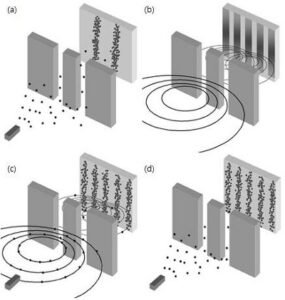
In summary, when waves that pass through two narrow, parallel slits, they form an interference pattern on a screen behind the slits (as shown in (b)). This holds true for all types of waves; light waves, water waves, sound waves, and so on.
When using solid particles (photons or electrons), logically, we would expect them to leave two lines as they pass through the two slits (as shown in (a)). However, when these particles pass through the slits, an interference/wave pattern is still formed (as shown in (d)). Even if only one particle passes through, it still forms an interference/wave pattern. It’s as if the particle travels through both slits at the same time.
Furthermore, even if these particles are sent through the slits one at a time, the interference/wave pattern is still formed (as shown in (d)). The wave is a wave of probability, as the experiment is set up so that the scientists don’t know which of the two slits any individual particle will pass through.
To observe what happens, scientists set up detectors in front of each slit to determine which slit the particle actually goes through. However, when trying to observe what happens, the particles act differently, forming two straight lines on the screen (as shown in (a)) as opposed to the interference/wave pattern (shown in (d)). This is true even when setting up the detectors behind the slits. No matter what the scientists do, if they try anything to observe the particles, the interference pattern does not show.
As such, the act of observation makes these particles act as we would expect (as solid matter as shown in (a)), but when not directly observed, the particles act as waves (as shown in (d)). It appears that our consciousness converts wave information into the seemingly solid world we see. As such, for example, if no one is observing your house, it is just a field of wave information that only assembles (as it is coded to) on conscious observation.
This also links with Billy Carson‘s research:
“Professor Sylvester James Gates Jr. from the University of Maryland, former scientific adviser to President Obama had a team of mathematics geniuses that discovered the universe is running off of something called Adinkra codes. These Adinkra codes are the exact error correcting codes that run search engines and web browsers. So, we’re living in a creation. We are living inside of a creation. The method of creation in my opinion is a fractal holographic universe and that it’s running on a particular code and this code or some of these codes are called the dinker codes that direct the fabric of spacetime itself. This is incredible knowledge to have because it shows you that all of the ancients were right; the biblical texts, the Quran, and all the ancient texts from thousands of years prior to them say that we’re living inside of creation.Time was given to us as a gift to direct us and give us this opportunity to collaborate within our field.”
The Delayed Choice Experiment 😮
Following on from this, scientists tried a variation test on the Double Slit Experiment (also known as the Delayed Choice Experiment). The scientists placed a particular crystal at each slit. These crystals split incoming particles into a pair of identical particles. The idea being that one particle from the pair should create the standard interference/wave pattern, whilst the other travels to a detector.
However, this still doesn’t work and to make things more strange, it doesn’t work regardless of when that detection happens. For example, if the second particle is detected after the first particle hits the screen, it still ruins the interference/wave pattern. This means that observing a particle can change events that have already happened.
This is one of the greatest mysteries of quantum mechanics.
The Double Slit Experiment Video Explanations 🎥
Below are some videos explaining the Double Slit Experiment and particle wave duality experiment, starting with the Dr. Quantum Double Slit Experiment video. Note also that the Holographic Universe theory is often referred to when talking about the Double Slit Experiment. You can check out our post on the Holographic Universe here.
These videos explore how reality is deeply tied to quantum physics, consciousness, and the role of the observer, suggesting that the universe is far stranger and more mind-dependent than everyday intuition assumes.
The first video explains the ‘Double Slit Experiment’, where particles like electrons behave differently depending on whether they are observed. It describes how particles can produce an interference pattern (wave-like behavior) when unobserved, but act like individual particles when measured. This leads to the idea that observation influences physical reality, creating one of the central mysteries of quantum mechanics.
The second video expands on this interpretation, connecting the Double Slit Experiment to broader:
- Consciousness plays a fundamental role in shaping reality.
- Reality is not fully objective, but influenced by observation.
- Physics experiments suggest that “matter is not solid” in the classical sense, but behaves probabilistically until measured/observed.
- Quantum findings link to ideas from mysticism, philosophy, and ancient traditions (rediscovering ancient advanced knowledge).
- Everything is energy and that modern science is converging with older spiritual ideas.
The third video discusses our influence on reality and its significance:
- Consciousness is central or primary, and reality may be a mental or informational construct.
- Humans are not passive observers, but active participants in creating reality through perception and attention.
- Changing consciousness (thoughts, emotions, awareness) can influence personal and collective reality.
- Social systems and “default ways of living” are conditioned, and awakening or awareness is a way to change both personal experience and the wider world.
Quantum mechanics is evidence that consciousness influences or even creates reality. Understanding and shifting awareness can transform both individual experience and the world at large.


The Double Slit Experiment is often used to back up the Holographic Universe, an idea favoured by leading physicists in the World Science Festival. Former NASA physicist Tom Campbell refers to the Double Slit Experiment in the video below, where he also favours that consciousness is the primary source of reality and matter is dependent on consciousness.
In the video below, physicist Tom Campbell discusses that reality is fundamentally a simulation created by consciousness, not physical matter:
1. Consciousness is fundamental
- Consciousness is the primary “thing” that exists.
- Physical reality (what we see and touch) is secondary, essentially a rendered experience.
2. Reality as a simulation
- The universe works like a virtual reality system.
- Our brains don’t create consciousness; instead, they act like interfaces or receivers.
- What we perceive is like a data stream interpreted by our minds.
- The goal of existence is evolution of consciousness.
- To become less fearful, more cooperative, and more empathetic.
4. Free-will matters
- Humans have free-will, which allows meaningful choices.
- Growth comes from making better choices over time.
5. Physics and science fit in
- Modern physics (especially quantum mechanics) is seen as consistent with a simulation-like reality.
- Physical laws are like rules of the simulation, not ultimate truth.
6. Paranormal/non-physical experiences
- Things like intuition, out-of-body experiences (OBEs), or psi phenomena are explained as access to other “data streams” beyond physical reality.
In summary, Tom Campbell says reality isn’t a physical universe with consciousness inside it. It’s a consciousness system generating a virtual universe.

Here is a profound quote from Erwin Rudolf Josef Alexander Schrödinger, one of the pioneers of quantum mechanics.:
“You can’t divide or multiply consciousness. It’s formless, infinite, spaceless, timeless, irreducible, fundamental, unimaginable, but the source of imagination. It cannot be conceptualized, but is the source of conception. It cannot be perceived, but is the source of perception.”
Reality is made up of waves (as shown in the Double Slit Experiment and alluded to in the Law of Vibration) that our thoughts and feelings (energy/frequency/vibration) directly influence.
You can read more on the Double Slit Experiment here and the Holographic Universe here.