
Article Overview 🔎
- Who were the Sumerians?
- What are the Sumerian Clay Tablets?
- The Code of Ur-Nammu Laws (the Oldest Known Legal Code)
- The Sumerian Clay Tablets of Creation Translations
- The Ancient Sumerian’s Clay Tablets Images of Our Solar System and Flying Modes of Transport
- More Ancient Astrological Knowledge
- Ancient Sumerian Gods
- Sumerian Clay Tablet Videos
Who were the Sumerians? 👥
Sumer is the earliest known civilization in the historical region of ancient Mesopotamia (modern day Iraq and Iran). The Sumer people were among the first known civilizations in Mesopotamia (modern-day Iraq), flourishing around 3100–2000 BCE. They built city-states, developed one of the earliest writing systems (cuneiform), and made advances in mathematics, astronomy, and irrigation. Based on recent research, the Sumerians are likely to have lived much longer ago than 6000 years ago, contradictory to what is said in mainstream teachings. For example, Sumer is meant to predate ancient Egypt and modern archaeological findings suggest that Ancient Egypt was prevalent 12,000 years ago.
Key Aspects of Sumerian Civilization:
- City-States: Sumer was not a unified empire, but a collection of city-states, each with its own ruler. Major cities included Ur, Uruk, Lagash, Kish, and Nippur.
- Writing System: The Sumerians invented cuneiform, one of the first known writing systems, used for administrative records and literature.
- Religion: They were polytheistic, worshiping gods like Anu (sky god), Enlil (storm god), Inanna (love and war goddess), and Enki (wisdom and water god).
- Ziggurats: Massive temple structures built in city centers for religious purposes.
- Law and Governance: The Sumerians established early forms of government and legal codes, such as the Code of Ur-Nammu.
- Decline: Around 2000 BCE, Sumer fell under the control of the Amorites and later the Babylonians.
The rulers of Sumer were among the earliest recorded monarchs in history. They governed city-states such as Ur, Uruk, Lagash, and Kish. Their rule was often considered semi-divine, and they played a significant role in the political and religious life of Sumer.
Notable Kings of Sumeria and Sumerian Rulers:
- Etana of Kish (c. 3100 BCE) – A legendary king from the Sumerian King List, often associated with myths of ascending to heaven.
- Enmebaragesi of Kish (c. 2600 BCE) – The earliest historically confirmed ruler, known for military conquests.
- Gilgamesh of Uruk (c. 2600-2500 BCE) – A semi-mythical king, famous for The Epic of Gilgamesh, one of the world’s oldest literary works.
- Eannatum of Lagash (c. 2500 BCE) – Established one of the earliest empires by conquering several Sumerian city-states.
- Lugalzagesi of Umma (c. 2350 BCE) – The last Sumerian king before the rise of Sargon of Akkad.
- Ur-Nammu of Ur (c. 2100 BCE) – Founder of the Third Dynasty of Ur and creator of the earliest known legal code, the Code of Ur-Nammu.
- Shulgi of Ur (c. 2094-2047 BCE) – A powerful king who strengthened Sumer’s administration and culture.
After the reign of the Sumerian kings, Sumer was eventually absorbed into the Akkadian Empire under Sargon of Akkad (c. 2334-2279 BCE).
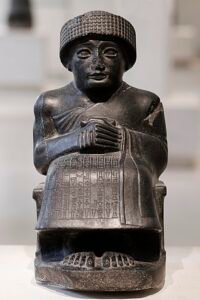
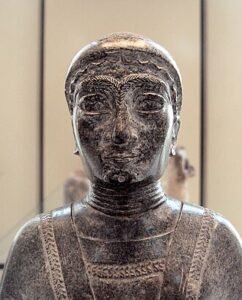
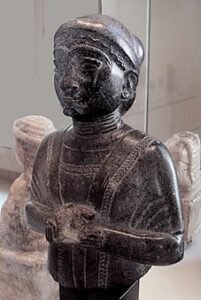
Despite the distance in time, many Sumerian Clay Tablets have been found in good condition, as they purposely used this material to stand the test of time. As of which have these Sumerian sculptures of rulers and royalty.
Gudea of Lagash, the Sumerian ruler who was famous for his numerous portrait sculptures that have been recovered:

Sumerian princess of the time of Gudea 2150_BCE:
What are the Sumerian Clay Tablets? 📜
The Sumerian Clay Tablets are ancient inscriptions made by the Sumerians, one of the earliest known civilizations, which thrived in Mesopotamia (modern-day Iraq) around 3100 BCE. These tablets were made of clay and inscribed using cuneiform script, one of the world’s first writing systems.
Purpose of the Sumerian Clay Tablets:
- Record-Keeping – Used for administrative purposes, tracking goods, taxes, trade, and laws.
- Literature & Mythology – Some tablets contain famous literary works like The Epic of Gilgamesh.
- Legal Codes – Early law systems such as the Code of Ur-Nammu were inscribed on tablets.
- Religious Texts – Prayers, hymns, and rituals dedicated to gods like Enlil and Inanna.
- Scientific & Mathematical Texts – Contained calculations, astronomical observations, and medical knowledge.
Famous Sumerian Tablets:
- The Epic of Gilgamesh – One of the earliest known literary works that some believe was based on a true story.
- The Instructions of Shuruppak – An early wisdom text.
- The Enuma Elish – A creation script, though more associated with later Mesopotamian cultures. You can read more on this here.
- Astronomical & Medical Texts – Containing knowledge of stars, diseases, and treatments.
- Drawings of the Solar System and Flying Modes of Transport – You can see these further down this page.
Many of these tablets have been excavated from ancient Sumerian cities like Ur, Uruk, Lagash, and Nippur. They provide invaluable insight into early human civilization, governance, mythology, and science.
The Code of Ur-Nammu Laws (Oldest Known Legal Code) ⚖️
Interestingly, the Code of Ur-Nammu (circa 2100–2050 BCE) is the oldest known legal code, predating the famous Code of Hammurabi by about 300 years. It was issued by King Ur-Nammu of Ur, a Sumerian city-state.
Key Features of the Code:
- Written in Sumerian cuneiform on clay tablets.
- Based on fines and compensation rather than harsh physical punishments.
- One of the first legal codes to establish the principle of “lex talionis” (punishment should fit the crime).
- Laws covered justice, property rights, marriage, and social order.
Examples of Laws from the Code of Ur-Nammu:
Murder & Assault:
- “If a man commits murder, that man must be killed.”
- “If a man causes another man’s eye to be put out, he shall pay half a mina of silver.”
- “If a man knocks out the tooth of another man, he shall pay two shekels of silver.”
Theft & Property Crimes:
- “If a man commits robbery, he shall be put to death.”
- “If a man seizes property of another, he must pay threefold restitution.”
Marriage & Family Laws:
- “If a man divorces his wife, he must pay her one mina of silver.”
- “If a man accuses his wife of adultery but she is found innocent, he must pay her silver.”
Slavery & Social Status:
- “If a slave marries a free person, their children shall be free.”
- “If a man injures a slave, he must compensate the owner.”
False Accusations & Legal Proceedings:
This code reflects a society trying to maintain order, fairness, and economic stability. Unlike Hammurabi’s later laws, which relied on severe physical punishment, Ur-Nammu’s code relied more on fines and compensation.
The Sumerian Clay Tablets of Creation Translations 🗣️
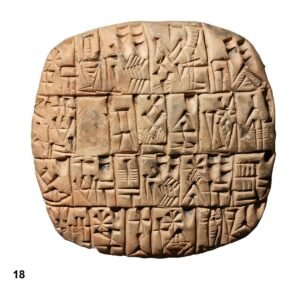
The language of Sumer was Sumerian, a language isolate spoken in southern Mesopotamia (modern-day Iraq) and the oldest attested language with written evidence, dating back to at least 3100 BCE. Here is an image showing the cuneiform language of Sumer written into an ancient Sumerian Clay Tablet:
In the translation of the tablets, it is said that Sumerians are a product of the Anunnaki (Anunnaki literally translates as “Those who came from heaven to Earth”), a civilization that visited Earth from a planet called Nibiru (also known as Planet X and some believe it to be Planet 9). Many researchers suggest that Nibiru could be a planet of our solar system with a longer orbit that takes thousands of years to come into closer vicinity. Some believe there’s a brown dwarf star in our solar system that Nibiru orbits around.
The tablets also say that the Anunnaki created us from 80% their DNA and 20% neanderthal DNA at the time to create us in their image so that we could mine gold and other resources. This is said to have happened as long as 200,000 years ago (you can read more on this from the most ancient tablets, inscribed with the creation of the solar system and humanity here).
Dr. Richard Alan Miller shares that the Sumerian tablets say that on death, we have the choice of going through the tunnel of light (back to source/heaven) or getting off the wheel (reincarnation).
Interestingly, the Anunnaki and Nibiru were mentioned on an episode of Scooby-Doo. There is a common pattern that occult truths and intentions are hidden in plain sight by elite powers with symbolism and subliminal messaging that they avoid karmic debt. However, ancient texts, insiders, and mediums (such as Rachel Vaughan) assert that this does not avoid karma at all, as the universe can read true intent and from intent, karma is created; people in the universe/creation cannot trick the creator of the universe/all that is!
More examples and explanations of symbolism in elite secret societies can be viewed here. Here the Scooby-Doo transcript and clip, that touches on both good and evil interdimensional beings (David Icke and others often speak of this) and them returning every few thousand years (linking to Zecharia Sitchin’s theory, as well as others) when it’s easier for them to access our realm through inhabiting physical bodies of animals.
“Nova? I am not Nova. I have only borrowed her body so that I may bring you an urgent message. Scooby-Doo, your life is in danger. Really? I am of the Anunnaki; interdimensional beings that visit the planet Earth every few thousand years. We arrive at a time called Nibiru, when the barriers between our worlds grow weak. The Anunnaki have a great history of helping humans, but we have no physical form and must inhabit animals. This is why some animals, our descendants, can talk and others cannot, but not all Anunnaki are kind and good. There are evil ones and the most evil one of all is imprisoned beneath Crystal Cove and must not be set free. You must undo it, Scooby-Doo. Undo it all. Save yourself. Save your friends. Save the world.”
The Ancient Sumerian’s Clay Tablets Images of Our Solar System and Flying Modes of Transport 🪐
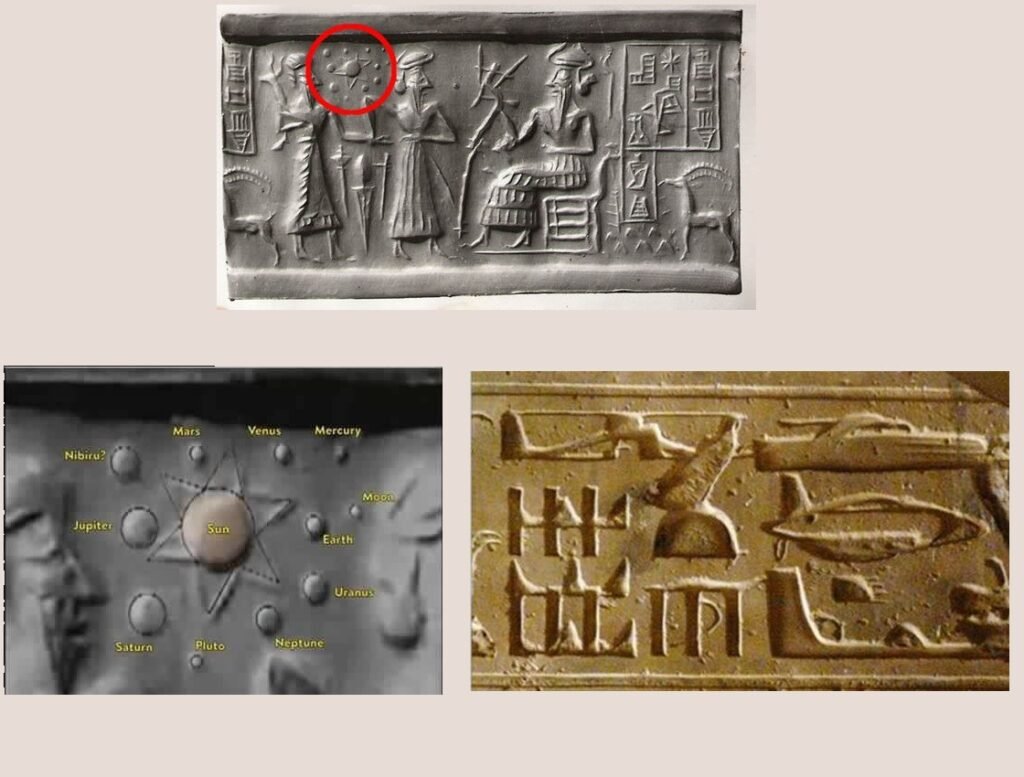
These tablets defy the common narrative that suggests human civilization began as less knowledgeable and evolved through time. This is because they show things such as our solar system and what appears to be flying modes of transport (including a helicopter and possibly a spaceship and submarine) as shown in the images below:
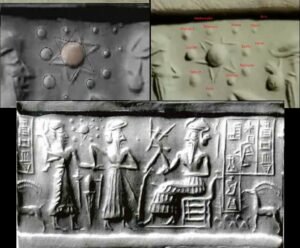
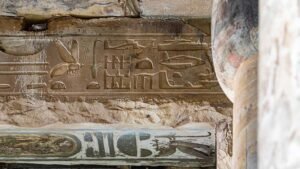
The tablets show the planets of our solar system to scale, with an additional extra planet. Many researchers believe that there is sufficient evidence to suggest that a planet was destroyed (which many believe to be Tiamat), making the asteroid belt. This planet that was destroyed could also represent planet Nibiru (Planet X), or Nibiru could still be intact, just not as observable due to the unique orbit mentioned that takes it much further away for many years. The inhabitants of this planet (the Anunnaki) shared all of this knowledge on our solar system (such as the colours of Neptune and Uranus as a blue-green) as well as others.
In addition, the Sumerian tablets include a sculpture of what appears to be a giant sitting with smaller people around it, as shown below:
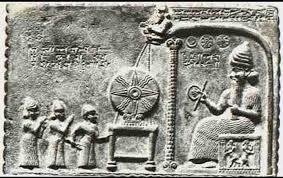
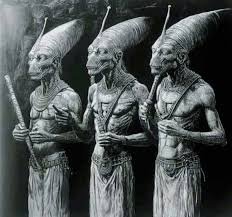
Below, there is an AI video animating some of the most profound ancient tablet sculptures and the stories that they could be telling, followed by artwork depicting how the Anunnaki could have looked based on the imagery of the ancient sculptures. The AI video includes extraterrestrials (or non-human beings), creation of life, DNA manipulation, and energy harvesting:
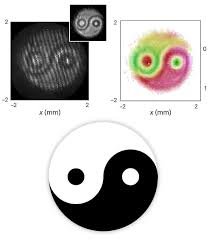
The imagery in these ancient Sumerian sculptures links with the advanced knowledge of other ancient cultures. For example, in the image below there are two entangled light particles naturally forming a yin-yang pattern in pink and green! The yin-yang was used in Chinese philosophy over 3000 years ago and is likely to have dated back from ancient knowledge like that of Sumeria. Scientists used a super-fast camera and a new technique called biphoton digital holography, at the University of Ottawa to get a real-time image, which could help advance quantum computing technology.
This links with more findings showing that ancient cultures were a lot more advanced than portrayed by the mainstream, such as the image below of two entangled light particles naturally forming a yin-yang pattern in pink and green! Scientists used a super-fast camera and a new technique called biphoton digital holography, at the University of Ottawa to get a real-time image, which could help advance quantum computing technology.
More Ancient Astrological Knowledge 🌌
The Dogon Tribe are another example of the Anunnaki sharing their knowledge of the cosmos. Originally of Ancient Egypt (called Kem at the time) and now of Mali, the tribe have access to this ancient information and accurately described Sirius B (that can only be seen with a telescope) of the binary star system of Sirius A and B. This has only just been discovered in recent years by modern science. They believe that Sirius B is where the Anunnaki come from and this is why there is a lot of reference and worship to Sirius in Ancient Egypt.
Below is a video from Bright Insight that touches on the asteroid belt being the remnants of a destroyed planet, linking to the extra planet shown in our solar system on the tablets. Studies from Nature Astronomy support the idea that the asteroid belt formed from collisions between planets or planetoids, rather than from leftover material from the solar system’s formation where:
- Much (possibly all) of the asteroid belt may come from 5–6 destroyed planetoids.
- Meteorites seen on Earth could be fragments of these destroyed worlds.
- The exact details of these collisions (timing, angles, velocities) remain uncertain.
A hypothetical distant planet (often called “Planet 9” or “Planet X”) could have caused gravitational disturbances leading to these collisions. This same object might also explain planetary tilts and even Earth’s geomagnetic pole shifts. Recent findings about organic molecules on Saturn’s moon Enceladus suggest extraterrestrial life may exist in the solar system.

Check out our Sirius Clothing Range:
- Sale!

Sirius All Star T-Shirt – Unisex 100% Cotton Inspirational Tee | Mind Expanding Clothes
Original price was: $39.99.$31.99Current price is: $31.99. Select options This product has multiple variants. The options may be chosen on the product page - Sale!
Sirius All Star Tank Top – Unisex 100% Cotton Inspirational Vest | Mind Expanding Clothes
Original price was: $37.99.$30.39Current price is: $30.39. Select options This product has multiple variants. The options may be chosen on the product page - Sale!
Sirius All Star Hat – Inspirational Cuffed Beanie Unisex | Mind Expanding Clothes
Original price was: $32.99.$26.39Current price is: $26.39. Select options This product has multiple variants. The options may be chosen on the product page - Sale!
Sirius All Star Trucker Cap – Unisex Inspirational Hat | Mind Expanding Clothes
Original price was: $39.99.$31.99Current price is: $31.99. Select options This product has multiple variants. The options may be chosen on the product page - Sale!
Sirius All Star Snapback Cap – Unisex Inspirational Hat | Mind Expanding Clothes
Original price was: $46.99.$37.59Current price is: $37.59. Select options This product has multiple variants. The options may be chosen on the product page - Sale!
Sirius All Star Bucket Hat – Unisex Organic Pure Cotton Inspirational Summer Hat
Original price was: $39.99.$31.99Current price is: $31.99. Select options This product has multiple variants. The options may be chosen on the product page






Ancient Sumerian Gods 🙏
The Sumerian pantheon included deities like An (sky god), Enlil (god of wind and storms), Enki (god of water and wisdom), Ninhursag (goddess of fertility), and Utu (sun god), among others.
Here’s a more detailed look at some key ancient Sumer gods and goddesses:
- An: The god of the heavens.
- Enlil: The god of wind, air, earth, and storms, considered a central figure in the Sumerian pantheon.
- Enki: The god of water, wisdom, and creation, also known as Ea in later Mesopotamian mythology.
- Ninhursag: The goddess of fertility, nature, and the earth, also known as the “Mother of the Gods”.
- Inanna: The goddess of love, fertility, war, and wisdom, and a powerful deity in the Sumerian pantheon.
- Utu: The god of the sun and justice, also known as Shamash in later Mesopotamian mythology.
- Nanna: The god of the moon.
- Ereshkigal: The goddess of the underworld.
- Ninurta: The great warrior god of the Sumerian pantheon and son of Enlil.
- Ninlil: The consort of Enlil and a deity of destiny.
- Nergal: The god of death, destruction, and war.
- Nammu: The primeval Sumerian mother goddess, who gave birth to the gods and created humanity.
Sumerian Clay Tablet Videos 🎥
The videos below from Bright Insight also give a further insight into the clay tablets.
Video 1 – Ancient Sumerians & Modern Education’s Exclusion of Them
This video touches on how the ancient Sumerians, one of the earliest civilizations in Mesopotamia, are under-taught in modern education despite their major contributions. They credit the Sumerians with foundational developments such as:
- The first writing system (cuneiform)
- A base-60 numerical system (used for time and angles)
- Early versions of the calendar
- Key inventions like the wheel, plow, irrigation systems, maps, contracts, and schools
- Cultural elements like music, instruments, beer production, and organized entertainment
The speaker emphasizes that much of what we use today originates from Sumerian innovations, yet they claim schools barely cover this history.
Also, discoveries of thousands of clay tablets (e.g. from the Library of Ashurbanipal), which reveal Sumerian knowledge and culture, attributing their knowledge to beings called the Anunnaki, which leads into speculation about the ancient astronaut hypothesis (the idea that extraterrestrials influenced early civilizations):
- That Sumerians had advanced knowledge of astronomy (e.g., planets orbiting the sun)
- That their texts accurately describe events like a global flood
- That religious stories (e.g. Moses) originated from earlier Sumerian accounts
- That mainstream academia ignores or suppresses this information

Video 2 – Origins of Humanity & Ancient Myths
The origins of human civilization, suggesting that ancient myths, archaeological mysteries, and scientific gaps might point to lost advanced civilizations or even extraterrestrial influence:
1. Ancient Civilizations & Lost History
- The Sumerians (6,000 years ago) are presented as the earliest known civilization with advanced knowledge.
- Older sites like Göbekli Tepe (12,000 years) and possible earlier dating of the Great Sphinx suggest civilization may be far older than traditionally believed.
- Despite humans existing for 300,000+ years, our recorded history is very limited.
2. Myths May Contain Truth
- Many cultures share similar myths (creation stories, gods descending from the sky etc.).
- Myths may be distorted versions of real historical events (“history turns to legend, which turns to myth”).
3. Global Flood Evidence
- Flood myths appear in over 500 cultures.
- Scientific evidence (ice cores, sea-level rise after the last Ice Age) suggests real large-scale flooding events, possibly inspiring these stories.
4. Extreme Longevity Legends
- Ancient texts (Sumerian king lists, Bible, other religions) describe humans living hundreds or thousands of years.
- There could be some truth, especially as modern science (e.g. stem cells) is extending human lifespan.
5. Advanced Ancient Knowledge
- Structures like the Great Pyramid of Giza may show advanced mathematical or geographical knowledge.
- Their true purpose remains unknown, challenging mainstream explanations.
6. Creation Myths & “Sky Beings”
- Many cultures describe beings (gods, angels) coming to Earth and creating humans.
- These could be interpreted as extraterrestrials.
- Sumerian tablets and global artwork are cited as possible depictions of such beings.
7. Genetic Engineering Idea
- The theory proposes that advanced beings may have manipulated human DNA.
- Modern science (cloning, gene research) shows such ideas are no longer purely fictional.
8. Gaps in Human Evolution
- The fossil record for human evolution is described as incomplete.
- Missing links and genetic mysteries (e.g. Y-chromosome gaps) aren’t explained in mainstream ideas.
9. Open-Minded Speculation
- These ideas deserve consideration.
- Resistance to such theories may come from cultural or religious discomfort.
10. Bigger Questions
If external beings influenced humanity:
- Why did they come?
- Are we being observed?
- Are we part of an experiment?

Video 3 – Visiting Iraq & The Lamassu Statues (Winged Human-Headed Bulls)
Jimmy (from Bright Insight) describes his personal experience visiting ancient ruins in Mosul, Iraq (Iraq was called Mesopotamia in ancient times and Sumeria was a southern region of Mesopotamia), during a military deployment in 2010. He focuses on a historic site in the Nineveh province, traditionally associated with the biblical story of Jonah.
He explains that the site includes large ancient gates, walls over 30 feet high, and massive statues known as “lamassu” (winged human-headed bulls), believed to originate from the Assyrian civilization thousands of years ago. He emphasizes their size, detail, and the vast area they cover, suggesting the civilization that built them was highly advanced.
Jimmy is particularly struck by the craftsmanship of the statues, which he claims are made of very hard stone (quartzite). He questions how such precise carvings could have been achieved with the limited tools of the Bronze Age, suggesting this might indicate the existence of lost advanced ancient technology.
He also notes the poor condition of the site during his visit, with war damage and lack of preservation, and references ISIS destroying some of the artifacts in recent years.
Additionally, he briefly discusses St. Elijah’s Monastery, a 6th-century religious site in Iraq that was also destroyed by ISIS, highlighting its long and violent history.

Video 4
This video touches on how important knowledge about the cosmos and possible connections to ancient civilizations is ignored or suppressed by mainstream science and education. This includes that:
- The solar system contains unexplained anomalies.
- Ancient civilizations may have had advanced cosmic knowledge.
- Modern institutions suppress or distort this information.
- Numerical patterns (like 108 and 432) are key evidence of this hidden understanding.
1. Unusual Features in the Solar System
- Bright spots on Ceres, officially explained as salt deposits, seem more mysterious.
- The asteroid belt may be the remains of a destroyed planet rather than failed planet formation.
- Mars once had life and that its surface features may be too well-preserved to be billions of years old (more on extraterrestrial life can be viewed here).
- A large upright “monolith-like” object on Phobos, is unexplained and under-discussed.
- The hexagonal storm on Saturn is a remarkable natural phenomenon (this is discussed more here).
2. Scientific Narratives
Scientists can be dismissive of alternative theories (like planetary destruction) and institutions like NASA:
- Use misleading “false color” images (more can be read on NASA allegedly editing images here).
- Present space visuals that don’t reflect what the human eye would actually see.
- Did not directly image black holes, only inferred.
3. “Cosmic Coincidences” and Numbers
There are recurring numbers 432 and 108 in:
- Astronomical measurements (Sun, Moon, Earth relationships).
- Ancient traditions and ancient texts.
- Ratios between Earth, Moon, and Sun align with these numbers and they enable phenomena like solar eclipses and tides.
4. Ancient Knowledge Hypothesis
Ancient civilizations knew advanced astronomical data.
- Great Pyramid of Giza proportions allegedly encoding Earth’s dimensions.
- Cultural uses of 108 in Hinduism, Buddhism, and other traditions.
- Myths and legends may preserve real historical knowledge.
5. Modern Symbolism and Hidden Knowledge
The number 108 appears intentionally in modern media like the series Lost (more on elite powers presenting symbolism in media and society as a whole can be viewed here).
Influential elite groups (like The Illuminati) may possess hidden knowledge and encode it symbolically in media and institutions (e.g. the Pentagon shape).
6. Suppression of Information
Discoveries related to ancient history are hidden or restricted, such as:
- Chambers beneath the Great Sphinx of Giza.
- Newly discovered voids in the Great Pyramid.
- Mainstream academia is deliberately withholding or ignoring evidence of advanced ancient civilizations.

You can read more on the Sumerians in the Sumerian category here.