
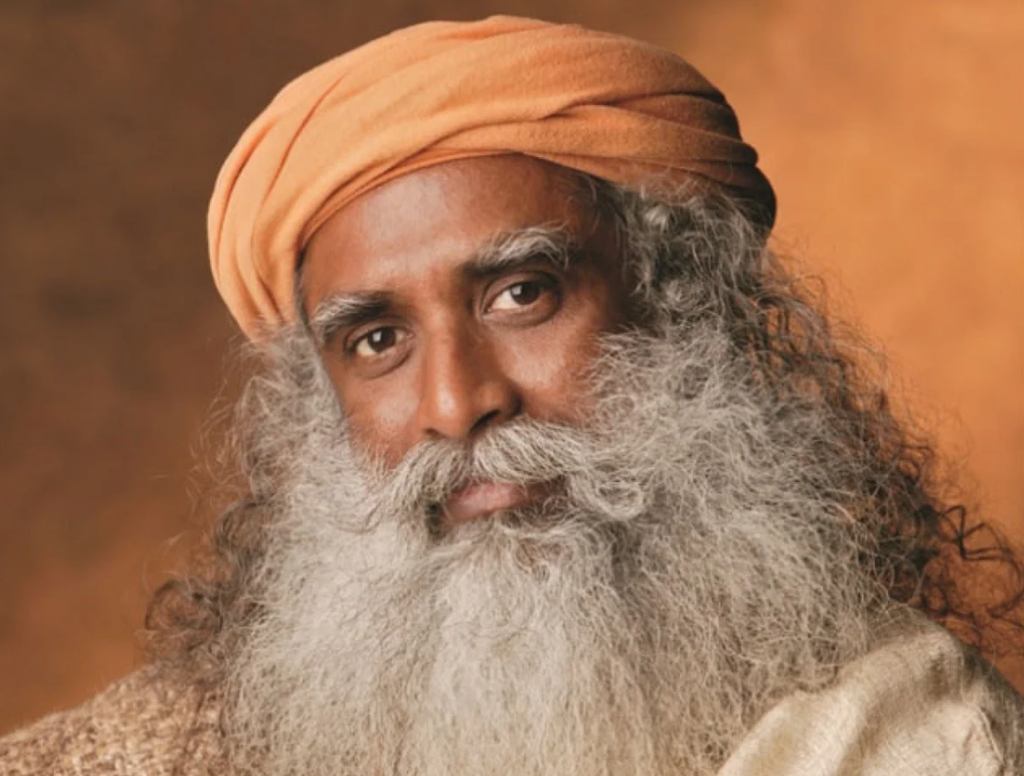
Who is Sadhguru? 🧘
Sadhguru (born Jagadish ‘Jaggi’ Vasudev, 3 September 1957) is described as a wise teacher with a logical and practical demeanor. He is the founder and head of the Isha Foundation, based in Coimbatore, India, established in 1992. The foundation operates an ashram and yoga center that carries out educational and spiritual activities. Sadhguru has been teaching yoga since 1982. He holds he is a yogi and doesn’t identify with s religion because he feels that religious identities are not healthy.
He is the author of the New York Times bestsellers Inner Engineering: A Yogi’s Guide to Joy and Karma: A Yogi’s Guide to Crafting Your Destiny, and has a portfolio of highly acclaimed books here. He is a frequent speaker at international forums, traveling the world speaking at places like Google, Microsoft, Harvard, Oxford, and the United Nations.
Who was Sadhguru Sri Brahma? 🔥
Sadhguru Sri Brahma was a powerful yogi and mystic who lived over 400 years ago in the Velliangiri Hills (Tamil Nadu, India). He is said to have been a fierce ascetic and an enlightened being who worked intensely to raise human consciousness. According to Sadhguru Jaggi Vasudev, Sadhguru Sri Brahma was his spiritual predecessor and had a significant role in shaping the spiritual energy of the Dhyanalinga, a powerful meditative space consecrated by Sadhguru in Coimbatore.
Sadhguru narrates that Sadhguru Sri Brahma attempted to create the Dhyanalinga, but could not complete the process due to various reasons. Sadhguru claims that he took up this unfinished task in this lifetime and successfully consecrated the Dhyanalinga in 1999.
Sadhguru Jaggi Vasudev regards Sadhguru Sri Brahma as a reminder of the importance of balancing inner intensity with external adaptability. While acknowledging his own fiery nature, Sadhguru emphasizes maintaining a controlled flame to effectively fulfill his mission without alienating society, a lesson drawn from Sadhguru Sri Brahma’s experiences.
Sadhguru’s Teachings 🧠
Here are some of his main teachings:
- Give your conclusions
- Don’t talk about anything that is not in your experience
- Don’t be positive or negative – just see it the way it is
- Look at what binds you
- Change yourself – don’t try to change anyone else
- Get rid of your ‘but’
- You have to do it the way it works
- Act consciously, not compulsively
- Don’t take your mind too seriously
- Find out for yourself
Sadhguru’s Videos 🎥
Check out the Sadhguru videos below for more on his teachings.
Video 1 – Sadhguru: How To Escape The Prison of The Mind
Sadhguru explains that human suffering is not caused by life itself, but by two uniquely human faculties; memory and imagination.
- We don’t suffer the past or future directly; those don’t exist in present reality.
- Instead, we suffer our memory of the past and imagination of the future.
- Humans mistake thoughts and emotions for reality, and give them more power than the present moment.
- This creates psychological “ghosts” that feel real but are self-created.
- If humans had less memory/imagination (like animals), they might be peaceful, but also lose creativity and possibility.
- Imagination becomes more “real” than reality itself, leading to emotional and mental entanglement.
- Suffering is self-created through uncontrolled memory and imagination.
Note that this links to scientific findings like the brain not being able to distinguish thought/feelings from physical reality and the Law of Attraction. This can be turned from “imprisonment”/”suffering” into freedom/empowerment by focusing thoughts on what you do want, in turn, feeling better in the present moment and attracting/manifesting these into physical reality.

Video 2 – Inner Management (Sadhguru)
Sadhguru discusses the idea that life is fundamentally management.
- Life quality depends on how well we manage the body, mind, emotions, and external situations.
- Modern society focuses heavily on external management (money, business, success), but neglects inner management.
- Many people suffer success just as much as failure because they lack inner stability.
- Stress is not caused by work itself but by lack of self-management.
- True management means not controlling others by force, but creating environments where people naturally perform their best.
- Without inner management, external success leads to anxiety, stress, and imbalance.
- Real leadership uplifts people, not just output.
External success without inner mastery leads to suffering; real management begins within.

Video 3 – What is the Purpose of Life? (Sadhguru)
Sadhguru challenges the idea of a “purpose of life”.
- Life does not need a purpose or meaning imposed on it.
- Seeking a fixed purpose often leads to psychological traps, dogma, and even harmful ideologies.
- A “God-given purpose” can make people justify extreme actions.
- Life is already profound and limitless without needing justification.
- Purpose creates mental confinement; people become trapped in identities and beliefs.
- The real alternative is not purpose, but full participation in life, experiencing life completely and consciously.
- Life is not a problem to solve but an experience to live fully.
Purpose is a mental construct; true fulfillment comes from total engagement with life itself.

Video 4 – Tips to Eat Right & Sleep Less (Sadhguru)
Sadhguru also discusses his research on the foods that have positive and negative influence on the body’s health. He explains that food is not cultural or religious, it is simply fuel for the body, and how we eat determines how efficiently the system runs.
The body is like a machine; food is its fuel:
- Eating habits strongly affect energy levels, focus and intelligence, and sleep requirement.
- Human digestion is optimized for proper chewing and partial digestion in the mouth (saliva enzymes start breaking down food).
- Modern eating habits often overload digestion, creating inertia (tamasic quality), sluggishness, and increased need for sleep.
Yogic classification of food effects:
- Tamas – Heaviness, inertia, sleepiness.
- Rajas – Overactivity, restlessness.
- Sattva – Balanced, clear, steady energy (ideal for learning).
Main dietary suggestions:
- Eat in a way that supports clarity and focus, especially for students.
- Prefer light, simple food; fruits, vegetables, nuts, sprouts.
- Avoid overly complex foods (especially heavy animal foods) because they carry more “biological complexity” and increase system load and sluggishness
- At least 40-50% of food should be raw/live to reduce inertia.
Sleep and efficiency:
- Poor eating increases sleep needs.
- With proper food and simple practices (including posture and activity), sleep can naturally reduce.
- He claims yogic lifestyle can reduce sleep to 2-4 hours without fatigue, because the system becomes more efficient.
Less inertia in the body means less sleep, more alertness, and higher focus.

Video 5 – Intermittent Fasting: Handle Your Health Problems The Natural Way
Sadhguru expands on timing, quantity, and frequency of eating and how modern science is only recently rediscovering what yogic tradition already knew.
Eating habits and the body:
- Humans generally eat too much and too frequently.
- The body performs best when the stomach is empty periodically and digestion is completed before the next meal.
Eating structure:
- Ideally, there should be an 8-hour gap between meals.
- In many yogic settings two meals per day are standard or even one meal a day in some cases.
Empty stomach vs hunger:
- Empty stomach ≠ starvation.
- Empty stomach improves clarity, energy efficiency, and mental alertness.
- Hunger (energy drop) is different from simply not eating constantly.
Sleep and lifestyle:
- Excess food intake increases inertia, sleep requirement, and sluggishness.
- When digestion is light, sleep requirement naturally reduces and the body functions more efficiently.
When the system is not overloaded :
- Less food is needed.
- Less sleep is needed.
- More energy becomes available for activity and awareness.
On modern habits and misunderstanding:
- People assume “more food = more strength” and “7-8 hours sleep is mandatory for everyone”.
- This is not universal; it depends on system efficiency.
Overfeeding creates a low-efficiency body that needs more sleep and becomes less capable of sustained alertness.

More can be read on Sadhguru via his category here or on Sadhguru’s website here.