
Article Overview 🔎
- What is the Holographic Universe/Simulated Universe Theory?
- World Science Festival Physicists explaining the Holographic Universe
- Living in a Simulation Explained
- The Holographic Universe Documentaries
- The Illusion of Reality
- Consciousness and The Big Bang
What is the Holographic Universe/Simulated Universe Theory? 🌌
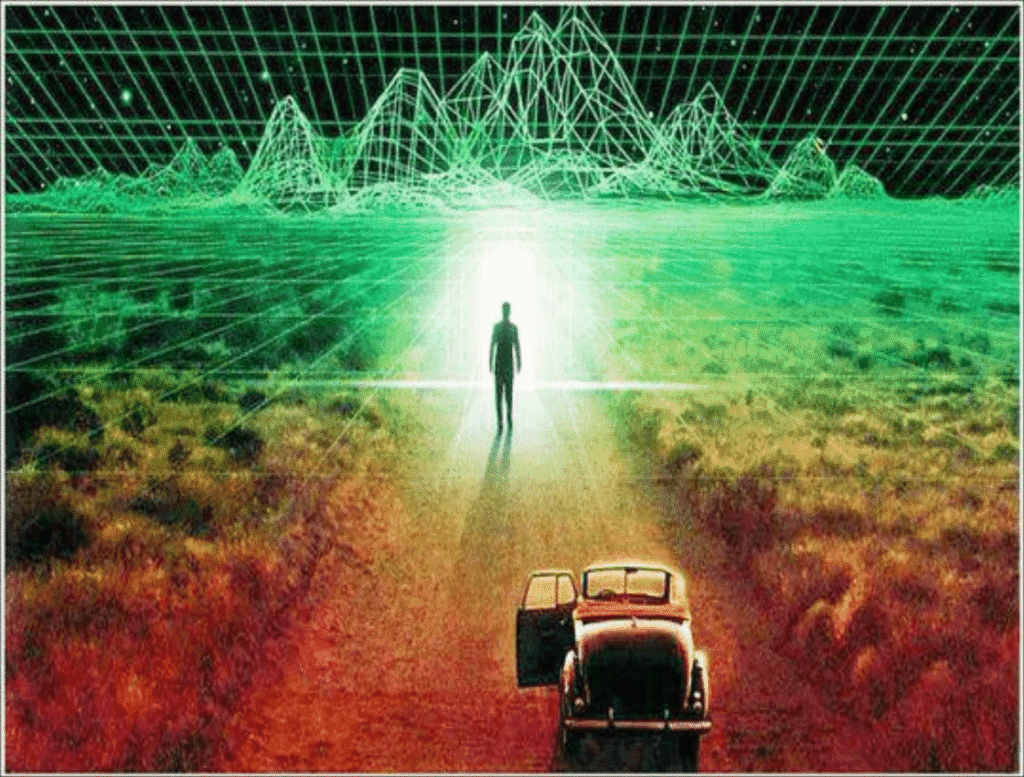
Physicists are discovering more and more evidence suggesting that the universe is holographic in nature. Household names like Elon Musk believe we live in a simulation and the concept has been discussed by reputable physicists on renowned platforms such as World Science Festival and TED Talks.
The concept is based on a number of principles. These principles include the idea that everything you experience is how your brain (your consciousness filter to experience this reality) is decoding waves and electrical signals. Your brain perceives information in “the field” to make up this reality. For example, if you touch the surface of something, the sensation of feeling the surface is your brain decoding those signals into the sensation of touch. If you hear something, it is your brain decoding those signals into sound. If you see something with your eyes, your brain decodes those signals to show imagery and so on for each sense.
Physicists have found that the human eye can only see 0.0035% of reality. The entire rainbow of radiation observable to the human eye only makes up about 0.0035% of the electromagnetic spectrum.
One famous experiment that is often referred to regarding the Holographic Universe is the Double Slit Experiment. This experiment shows that seemingly solid particles act as waves until observed by consciousness. The act of observing particles directly affects their behaviour. More can be read on this here.
Former NASA physicist Tom Campbell also favours the Holographic Universe concept. He refers to the Double Slit Experiment when explaining why he believes that consciousness is the primary source of reality and matter is dependent on consciousness. This is because the act of conscious observation affects the way particles behave.
Nikola Tesla famously said, “If you want to find the secrets of the universe, think in terms of energy, frequency, and vibration.” Albert Einstein was quoted, “Concerning matter, we have been all wrong. What we have called matter is energy, whose vibration has been so lowered as to be perceptible to the senses. There is no matter.” These are two of the greatest scientific minds implying that physical matter is secondary to non-physical vibration/waves (consciousness/thoughts).
Ancients believe that our dreams are closer to reality than what we consciously experience as dreaming takes you to a higher dimension from this 3D reality, to your higher self. The Aboriginals called this reality “dream time”, the Native American Hopi tribe called this “sleepy time” and that we have a higher self in a higher realm. Also, researchers in to ancient knowledge like Billy Carson say that lot of the time the voice we hear in our head is really our higher selves talking to us.
Billy Carson also shares that:
“Professor Sylvester James Gates Jr. from the University of Maryland, former scientific adviser to President Obama had a team of mathematics geniuses that discovered the universe is running off of something called Adinkra codes. These Adinkra codes are the exact error correcting codes that run search engines and web browsers. So, we’re living in a creation. We are living inside of a creation. The method of creation in my opinion is a fractal holographic universe and that it’s running on a particular code and this code or some of these codes are called the dinker codes that direct the fabric of spacetime itself. This is incredible knowledge to have because it shows you that all of the ancients were right; the biblical texts, the Quran, and all the ancient texts from thousands of years prior to them say that we’re living inside of creation.Time was given to us as a gift to direct us and give us this opportunity to collaborate within our field.”
Many reputable physicists describe consciousness as infinite, limitless, and non-local (not bound by space and time). Other researchers such as Deepak Chopra raise the fact that the top two unsolved mysteries in science are:
- What is the universe made of?
- What is the biological basis of consciousness?
Alex Collier refers to humans as “light beings” which is also used to describe humanity in ancient texts like the Emerald Tablets and he shares that is you use specific electron microscopes to look at the human body, it does not appear as any solid particles, but as light as we are light beings in a holographic matrix.
Deepak Chopra’s definition of consciousness is:
“Consciousness is the subject of all experience. It’s what experiences everything. The mind is made out of consciousness, it’s a modified form of consciousness. We have unique minds, but share the same consciousness.”
Erwin Rudolf Josef Alexander Schrödinger, one of the pioneers of quantum mechanics definition of consciousness is:
“You can’t divide or multiply consciousness. It’s formless, infinite, spaceless, timeless, irreducible, fundamental, unimaginable, but the source of imagination. It cannot be conceptualized, but is the source of conception. It cannot be perceived, but is the source of perception.”
“We are asleep. Our Life is a dream. But we wake up sometimes, just enough to know that we are dreaming,” Ludwig Wittgenstein.
When looking into subjects such as life after death, a recurring message is that you are infinite awareness having a human experience; you’re a soul that has embodied your body which filters everything else out so that you only perceive this level of reality for this experience.
There are a number of videos below discussing these different matters, starting with the World Science Festival.
Note that further down in the article, there are videos where physicists discuss that consciousness precedes The Big Bang and that consciousness is the creator of our reality. Also, there is more content on the mathematical nature of the universe in our Fibonacci Code/Golden Ratio article here.
Check out our Holographic Universe Clothing Range:
- Sale!

Holographic YOUniverse Tank Top – Unisex 100% Cotton Holographic Universe Vest
Original price was: $37.99.$30.39Current price is: $30.39. Select options This product has multiple variants. The options may be chosen on the product page - Sale!
Multiversal Simulation T-Shirt – Unisex 100% Cotton Holographic Universe Tee (White Text)
Original price was: $39.99.$31.99Current price is: $31.99. Select options This product has multiple variants. The options may be chosen on the product page - Sale!
Multiversal Simulation T-Shirt – Unisex 100% Cotton Holographic Universe Tee (Black Text)
Original price was: $39.99.$31.99Current price is: $31.99. Select options This product has multiple variants. The options may be chosen on the product page - Sale!
Holographic YOUniverse T-Shirt – Unisex 100% Cotton Holographic Universe Tee (White Text)
Original price was: $39.99.$31.99Current price is: $31.99. Select options This product has multiple variants. The options may be chosen on the product page - Sale!
Holographic YOUniverse T-Shirt – Unisex 100% Cotton Holographic Universe Tee (Navy Text)
Original price was: $39.99.$31.99Current price is: $31.99. Select options This product has multiple variants. The options may be chosen on the product page - Sale!
Holographic YOUniverse Bucket Hat – Unisex Organic Pure Cotton Summer Hat (White Text)
Original price was: $39.99.$31.99Current price is: $31.99. Select options This product has multiple variants. The options may be chosen on the product page - Sale!
Holographic YOUniverse Bucket Hat – Unisex Organic Pure Cotton Summer Hat (Navy Text)
Original price was: $39.99.$31.99Current price is: $31.99. Select options This product has multiple variants. The options may be chosen on the product page - Sale!
Multiversal Simulation Hat – Holographic Universe Cuffed Beanie Unisex (White Text)
Original price was: $32.99.$26.39Current price is: $26.39. Select options This product has multiple variants. The options may be chosen on the product page








The World Science Festival and Physicists Explaining the Holographic Universe 🧑🔬
These first set of videos below include explanations of the Holographic Universe/Simulation hypothesis from renowned physicists.
Video 1 – A Thin Sheet of Reality: The Universe as a Hologram | World Science Festival
The first video from World Science Festival has leading physicists talking about the holographic principle and the nature of reality.
The video discusses is the holographic principle (the universe as a hologram), an insight from modern physics suggesting that:
- All the information contained in our three-dimensional universe might actually be encoded on a two-dimensional surface (like a “thin sheet”).
- The three-dimensional world we experience; space, objects, and perhaps even time might emerge from deeper, more fundamental informational processes at a lower-dimensional boundary.
This idea emerged from studies in quantum gravity, especially attempts to reconcile quantum mechanics and general relativity. One foundational result comes from work on black holes. Black hole entropy (a measure of information) seems to scale with the area of the event horizon (2D surface), not the volume inside, suggesting information is stored on surfaces rather than in volumes.
The main topics discussed are:
1. Information and Space
The physicists explain how information (the fundamental “bits” of reality) may be preserved and encoded on surfaces. If true, this means what we perceive as the inside of space could just be a projection from that surface, much like a hologram.
2. Challenging Conventional Views
This perspective challenges our everyday intuition about space as volume and matter as inherently three-dimensional. Instead, it proposes that deeper laws of physics might treat our apparent 3D universe as an emergent phenomenon from underlying 2D information patterns.
3. Origins in Physics Theory
The holographic principle grew out of debates and puzzles in physics. For example, how to preserve information in black holes (the so-called information paradox). The panel discusses how these issues led theorists like Leonard Susskind and others to this idea.
4. Implications for Reality
If the holographic principle is correct, our universe might be thought of as a vast informational structure, with space emerging from information processing on a distant boundary (similar, metaphorically, to how a hologram encodes a 3D image on a flat surface).
Cutting-edge physics suggests that reality may be encoded like a hologram, with information on surfaces giving rise to the 3D universe we perceive. A major step in understanding quantum gravity and the nature of space-time.
Video 2 – Leonard Susskind on Richard Feynman, the Holographic Principle, and Unanswered Questions in Physics
In this video Leonard Susskind (Felix Bloch professor of Theoretical physics at Stanford University) discusses philosophy of science and quantum gravity. He says that he is not a contrarian, but someone who advances mainstream physics by resolving internal inconsistencies. His work is driven by paradoxes; when existing theories conflict, he searches for a deeper, consistent framework.
He discusses major ideas in modern theoretical physics like string theory as a useful mathematical framework (not necessarily the final theory of reality), the need to unify quantum mechanics and gravity, and unresolved problems in cosmology like dark energy and the lack of new particle physics results. He explains key concepts he helped develop or popularize, including black hole information theory, the holographic principle (that 3D physics can be encoded on a 2D boundary), and the ER=EPR idea linking quantum entanglement with spacetime geometry.
His philosophy is that modern physics should be used to resolve deep contradictions in quantum mechanics, gravity, and cosmology to reach a fully consistent description of reality.

Video 3 – The Case Against Reality | Prof. Donald Hoffman on Conscious Agent Theory
In this video, cognitive scientist Donald D. Hoffman discusses that we do not see reality as it truly is. Instead, our brains show us a simplified “interface” (like a computer desktop) that helps us survive (not the truth). This includes a few main concepts.
1. Evolution favors survival, not truth:
- Natural selection doesn’t reward accurate perception, it rewards useful perception.
- Creatures that see reality “as it is” are actually less likely to survive.
- Our senses evolved to hide reality and show only what helps us stay alive.
2. Reality is like a user interface and perception can be compared to a computer desktop:
- Icons (files, folders) are not the real circuitry inside the computer.
- Similarly, objects like tables, space, time are just “icons” our brain uses.
- They’re useful, but not fundamentally real.
3. Space and time may not be fundamental:
- Space-time itself might not be the true structure of reality.
- Space-time could be something our minds construct to make sense of the world.
4. Consciousness might be fundamental, rather than consciousness coming from the brain:
- Consciousness could be the basic building block of reality.
- Physical objects might emerge from it, not the other way around.
In summary, what you see, hear, and feel is not reality itself, but a useful illusion shaped by evolution, like a simplified dashboard that helps you navigate the world.

Videos 4 & 5 – Tom Campbell Insights
In these videos, physicist Tom Campbell discusses that reality is fundamentally a simulation created by consciousness, not physical matter:
1. Consciousness is fundamental
- Consciousness is the primary “thing” that exists.
- Physical reality (what we see and touch) is secondary, essentially a rendered experience.
2. Reality as a simulation
- The universe works like a virtual reality system.
- Our brains don’t create consciousness; instead, they act like interfaces or receivers.
- What we perceive is like a data stream interpreted by our minds.
- The goal of existence is evolution of consciousness.
- To become less fearful, more cooperative, and more empathetic.
4. Free-will matters
- Humans have free-will, which allows meaningful choices.
- Growth comes from making better choices over time.
5. Physics and science fit in
- Modern physics (especially quantum mechanics) is seen as consistent with a simulation-like reality.
- Physical laws are like rules of the simulation, not ultimate truth.
6. Paranormal/non-physical experiences
- Things like intuition, out-of-body experiences (OBEs), or psi phenomena are explained as access to other “data streams” beyond physical reality.
In summary, Tom Campbell says reality isn’t a physical universe with consciousness inside it. It’s a consciousness system generating a virtual universe.


Living in a Simulation Explained 🌐
The next set of videos explain the simulation hypothesis further, including Elon Musk and Deepak Chopra’s take on the holographic principle of the universe.
Video 1 – Why Elon Musk says we’re living in a simulation
This video presents the idea that we may be living in a computer simulation.
Elon Musk suggests there is an extremely low chance (“one in billions”) that we are in “base reality”, meaning most realities like ours are likely simulated. The argument is heavily based on work by philosopher Nick Bostrom, who proposes a trilemma of three possibilities:
- Civilizations almost always go extinct before reaching the ability to create realistic ancestor simulations.
- Advanced civilizations choose not to run such simulations (ethical or practical reasons).
- Advanced civilizations do run massive numbers of realistic simulations, meaning simulated observers vastly outnumber real ones.
If the last possibility is even somewhat true, then statistically it is more likely we are in a simulation.
The conversation extends with:
- Exponential future computing power (from games, to photorealistic worlds, to full brain emulation).
- “Ancestor simulations” containing conscious beings.
- Ethical concerns about suffering inside simulations.
Musk frames it as a binary future for civilization; either it becomes simulation-capable or goes extinct, making simulation probability high.

Video 2 – You are a Simulation & Physics Can Prove It: George Smoot at TEDxSalford
This video discusses the simulation idea into a broader philosophical and scientific argument.
Builds intuition using:
- Growth of computing (from Pong to modern simulations).
- The idea that future civilizations could simulate entire conscious worlds.
Connects to philosophical frameworks:
- Solipsism – Only your mind is certain to exist (unfalsifiable).
- Philosophical zombies – Beings that behave like humans but lack consciousness.
- Anthropic reasoning – The universe must allow observers like us.
Multiverse theory – Many universes exist, or alternatively many simulations exist.
Central argument:
- If simulation tech becomes possible, and if many civilizations reach it, simulated minds would vastly outnumber biological ones, making simulation statistically likely.
Additional topics:
- Limits of human cognition (illusions, Bayesian errors, misjudgment).
- Physics as a test of reality’s consistency.
- Brain emulation and mind uploading.
- Future AI/simulation environments that could feel subjectively real.
- Ethical uncertainty about creating conscious simulated beings.
In conclusion, we may not be well-equipped to determine what “reality” is, and physics might be the only tool that constrains the question.

Video 3 – Michael Talbot – Part 1 Complete- Synchronicity and the Holographic Universe – Thinking Allowed
This segment focuses on the holographic model of reality based on ideas from physicist David Bohm and neurophysiologist Karl Pribram (as discussed by author Michael Talbot in conversation with Jeffrey Mishlove).
Reality is a hologram and a hologram has key properties:
- Each part contains information about the whole.
- Cutting it still reproduces the entire image (though lower resolution).
This suggests that every part of the universe may contain information about the whole universe.
Pribram proposed:
- Memory is distributed, not localized in one brain region (like a mind cloud/Akashic records).
- The brain processes information using wave-like interference patterns (similar to holograms).
- Sensory systems may use similar mathematical transformations (Fourier transforms).
Quantum and nonlocality:
- Quantum entanglement suggests distant particles may behave as a unified system.
- Bohm’s interpretation – Separateness is an illusion; deeper reality is undivided.
Consciousness and reality:
- The perceived physical world may be like a “projection” of deeper informational reality.
- Mind and matter may not be strictly separate.
This framework is used to interpret:
- Placebo effects and psychosomatic healing.
- Psychokinesis (mind influencing matter).
- Near death experiences describing “energetic” or “holographic” realities.
Conclusion:
- Reality may be more like an interconnected information field than solid objects.
- Consciousness could play a fundamental role in shaping perceived reality.

Video 4 – Is Matter a Myth? Explore the Vibrant Energy of Our Empty Reality!
This video is a science-lecture-style explanation of matter, forces, and the idea that reality might allow overlapping “worlds” that pass through each other unseen.
Matter is mostly empty space:
- Everyday categories like solid, liquid, gas are described as superficial.
- Everything is made of atoms, which are themselves made of smaller particles.
- Even “solid” objects (metal, wood, air) are mostly empty space at the atomic level.
- The “solidness” we experience is not because matter is truly solid, but because of electromagnetic forces and interactions between atomic particles.
Forces, not contact, create “hardness”
- What we perceive as collisions (e.g. hitting a wall) are not solid objects touching.
- Instead, they are electromagnetic repulsion forces between atoms.
- These forces prevent matter from passing through matter.
If those forces did not exist a person could theoretically pass through a wall and matter would not feel solid at all. Therefore, “solidity” is an emergent effect of force interactions, not a fundamental property.
The video shows demonstrations of how electromagnetic forces behave:
- A magnet affects steel but not all materials (e.g. non-magnetic steel, aluminum, wood).
- Electrical currents can induce strong effects in metal loops (induction).
High-frequency or high-power electromagnetic fields can heat metal rapidly, ignite steel wool, and create visible energy effects without obvious physical contact. Some setups show:
- “Cold” objects producing heat effects (via induced currents).
- Selective interaction depending on material properties.
There are different “levels” of physical interaction:
- Some materials respond strongly to electromagnetic fields.
- Others appear unaffected.
- This creates the impression that matter behaves differently depending on hidden structures and forces.
- Speculative philosophical extension.
The transcript moves beyond physics into theoretical possibilities:
- Two separate “worlds” could occupy the same space.
- Each would be fully real internally, but not interact if their forces don’t couple.
In that scenario:
- Both worlds could coexist invisibly.
- Each would be unaware of the other.
- They would pass through each other without interaction.

The Holographic Universe Documentaries (two 5 Part Videos) 🎥
Below are two in depth Holographic Universe documentaries explaining the simulation universe:
Documentary 1 (5 videos):
Documentary 2 (5 videos):
The Illusion of Reality 👀
The illusionary nature of reality is discussed further in the videos below, which include insights from Professor Jiang Xueqin, David Icke, and Billy Carson. These insights are summarized below before the videos for reference.
Video 1 – Professor Jiang Xueqin: Great Books 1 Secrets of the Universe
In Professor Jiang Xueqin’s lecture, he tackles different layers of reality’s illusive nature. He starts by identifying that modern schools and science teach a “materialist worldview” where:
- Humans come from biological evolution.
- Reality is only what can be measured and observed.
- Consciousness is not adequately explained.
He calls this worldview deceptive because it does not answer:
- What consciousness is.
- How thinking and imagination arise.
- What it truly means to be human.
He sees that students are discouraged from asking these deeper metaphysical questions.
He says humans have two dimensions:
- Material – the physical body (product of evolution).
- Spiritual – a soul connected to the divine.
Humans contain a divine “spark” that enables love, imagination, and conscious participation in reality, with the two fundamental human acts being:
- Love – Which unifies with God/divine.
- Imagination – Which expands consciousness and creative power.
His teachings on the nature of the universe include that:
- The universe is not fundamentally material, but conscious.
- Reality is made of “vibrations and energy” (as famously said by Nikola Tesla).
- Consciousness arises from informational vibration.
- Material reality emerges from slowed vibrational states.
- The spiritual and material are always connected.
The key metaphysical model he presents is:
- A divine source (“Monad”) emanates reality through vibrational flow.
- Material existence is a lower-frequency expression of spiritual reality.
Using Kant’s philosophy, Professor Jiang Xueqin distinguishes:
- Noumena – reality “in itself” (ultimate reality, unknowable directly).
- Phenomena – reality as it appears to us through perception.
He suggests that:
- The brain converts spiritual reality (noumena) into perceived material reality (phenomena).
- The right brain receives deeper reality.
- The left brain translates it into sensory experience (drawing on Julian Jaynes–style ideas).
He describes consciousness as:
- Infinite-dimensional.
- Individually unique, but universally connected.
- Capable of linking across all beings.
- Participatory (humans help shape reality through imagination and attention).
Plato’s “Allegory of the Cave” is used to explain the human condition:
- Prisoners are put in cells where they can only see shadows projected onto the wall in front of them, they then mistake these shadows for reality.
- Hidden powers project illusions, with modern equivalents to this analogy being the media, internet, AI, and institutions.
- These systems are described as capturing attention and imagination to control reality.
Professor Jiang Xueqin goes on to then explain the difference between slavery and freedom:
Slavery = Mental/spiritual captivity through illusion.
Freedom = Awakening to deeper spiritual truth.
The freed prisoner initially suffers blindness from truth, but gradually sees real beauty and divine reality. This represents spiritual awakening.
He defines freedom as:
- Thinking for yourself.
- Rejecting imposed reality narratives.
- Turning inward toward spiritual truth.
- Connecting with the divine.
He defines slavery as:
- Accepting social conditioning.
- Pursuing money, fame, and status.
- Following institutional narratives.
- Choosing comfort over truth.
He emphasizes that:
- Slavery is ultimately a choice.
- Free-will is absolute.
- Most people will choose illusion over truth.
He speaks of how all religions are said to converge on meditation as the primary liberation method, as it:
- Aligns consciousness with universal vibrational flow.
- Uses breath and awareness.
- Harmonizes the mind with “sacred geometry”.
With the goal of meditation being to:
- Perceive true spiritual reality.
- Transcend bodily limitation.
- Access deeper consciousness.
He says that meditation takes decades of disciplined practice, but also speaks of hacks/shortcuts to access spiritual reality:
- Psychedelics – Alter brain filtering and perception (such as DMT and DMT brews like ayahuasca created by ancient Amazonians).
- Near Death Experiences (NDEs) – Reported encounters with divine light and love from dying and being brought back to life.
- Extreme self-denial – Prolonged fasting or starvation/exposure to cold without protection/physical hardship or austerity/pushing the body close to collapse (allegedly, some people in secret societies torture each other to point of death through things like freezing the body to induce near death experiences and gain more knowledge of reality, before bringing them back to life).
These are described as forced shifts into spiritual perception.
He explains that pain and suffering are framed as necessary because:
- They create meaning.
- They drive imagination and growth.
- Without struggle, virtue and creativity would be empty.
- Evil gives contrast that makes good meaningful.
He also speaks on Christ Consciousness, with Christian interpretations being that humans can become vessels for divine consciousness (Christ Consciousness can inhabit the person) through love, forgiveness (radical forgiveness opens divine presence), and generosity. He says that Jesus persists through collective belief and imagination, and that resurrection happens spiritually within believers.
He goes on to describe humans as active participants in reality (like pebbles creating waves in an ocean), and that reality changes through shared imagination and belief. Memory and imagination feed back into universal consciousness.
He says that the Greek concept of this invoked Eudaimonia, flourishing through creative fulfilment. The word literally translates as “the state or condition of good spirit”, which is commonly translated as happiness or welfare. In the works of Aristotle, eudaimonia was the term for the highest human good in older Greek tradition.
He lists three ultimate goals:
- Immortality
- Reincarnation
- Godhood
Which are achieved through:
- Love and imagination.
- Spiritual awakening.
- Conscious participation in reality.
- Alignment with divine vibration.
Consciousness is said to persist after death and return.

Video 2 – David Icke: The Holographic Illusion of Reality
In David Icke’s presentation, he discusses why physical reality is not truly solid or independent, but instead exists as a kind of illusion or holographic projection created by consciousness through perception. He compares reality to how a computer reads data from a disk; only the observed portion becomes visible, suggesting that observation “decodes” underlying information into experienced reality. He breaks this down as follows:
- Perception creates reality – The brain does not receive light directly, but decodes information into the experience of sight. Objects only exist in perceived form within consciousness.
- Reality is an illusion/hologram – Drawing on quantum physics and holography, the world is fundamentally information and vibration, not solidity. The apparent physical form is like a holographic projection from underlying wave patterns (again linking to findings of Nikola Tesla, as well as modern physics).
- Consciousness is primary – True identity is described as infinite awareness, not the body or mind. The body–mind is a temporary “vehicle” or interface that lets consciousness experience a specific frequency range called physical reality. Reality is a digital or holographic construct.
- Limits are belief-based – So called miracles (like walking on hot coals) are overriding mental programming about what is possible. Belief shapes perceived physical outcomes.
- Control through false identity – Power structures keep people controllable by convincing them they are only their limited physical identity instead of expansive consciousness.
- Death is not an end – It is described as simply stopping the focused experience (like putting down a telescope), while consciousness continues.
- Mind vs consciousness – Consciousness is like an ocean of possibility; the mind is a restricted, denser expression needed to interact with the physical world.
- Spiritual/psychedelic experience – Ayahuasca experiences reinforce the idea that vibrating reality is illusion, while ultimate truth is stillness and silence.

Video 3 – Billy Carson Fractal Holographic Universe
Billy Carson’s presentation covers the Universe as a Fractal Holographic Matrix. He discusses the idea that the universe is not solid matter, but a fractal holographic matrix of light and information. In this view, reality is structured in repeating self-similar patterns at every scale, from atoms to galaxies, much like a fractal. This concept blends ancient wisdom (e.g. Hermetic teachings like “As Above, So Below”) with modern cosmological theories about fractals and holography. This includes how:
- Reality and Consciousness Connected – The structure of reality is encoded like information (like a hologram), so that each part reflects the whole. This implies everything is interconnected. Carson suggests that consciousness plays an active role in shaping how this matrix unfolds; our awareness isn’t just a passive observer but part of the process of reality.
- Ancient Knowledge links to Modern Physics – The talk ties these fractal/holographic concepts to ancient civilizations’ insights, arguing that cultures like the Egyptians and Sumerians had deep knowledge of the universe that modern physics is proving to be true.
- Science and Existence is Implicated – Patterns repeat across scales (a hallmark of fractals) and this has implications for everything from physics to consciousness studies.
- Consciousness Affects Reality – Consciousness affects the physical, as found in quantum physics thought experiments like the Double Slit Experiment and Dr. Masaru Emoto’s experiments on how consciousness affects water particles (and particles as a whole).
Here are the broader themes from Carson’s presentation:
- Reality as an informational light matrix rather than dense matter.
- All things are interconnected through fractal patterns.
- Ancient metaphysics is being proven correct by modern science studies on consciousness and cosmology.

Consciousness and The Big Bang 💥
In the video below, physicists discuss more interesting beliefs. These include as how consciousness precedes The Big Bang and that consciousness is the creator of our reality:
You can read more on the Holographic Universe here and the Fibonacci Sequence here. Also, here is the World Science Festival’s official website for further reference – https://cdn.worldsciencefestival.com/